
Why Camera Based ARAS Is Winning for Motorcycle OEMs
Motorcycles are becoming software-defined products, not just mechanical machines with electronics added on top. For OEMs, that shift changes the role of rider safety systems. Advanced Rider Assistance Systems, or ARAS, now need to do more than warn about nearby vehicles. They need to understand the road, support new services, generate useful data, and keep improving after the motorcycle leaves the factory.
That is why AI-powered camera-based ARAS is gaining momentum. Radar remains a valuable sensing technology, especially for measuring distance and relative speed. But cameras bring a much richer layer of information. They can interpret the road scene in ways that support safety, insurance, rider experience, analytics, and future software updates.

Cameras and radar solve different problems
The camera-versus-radar discussion is often framed as a winner-takes-all contest. In practice, the two technologies see the world differently.
Radar is excellent at measuring:
Distance to an object
Relative speed
Object movement in low-visibility conditions
Closing speed between vehicles
That makes radar especially useful for functions such as blind spot detection, forward collision warning, and adaptive speed-related features. It is also less affected by darkness, glare, or some weather conditions.
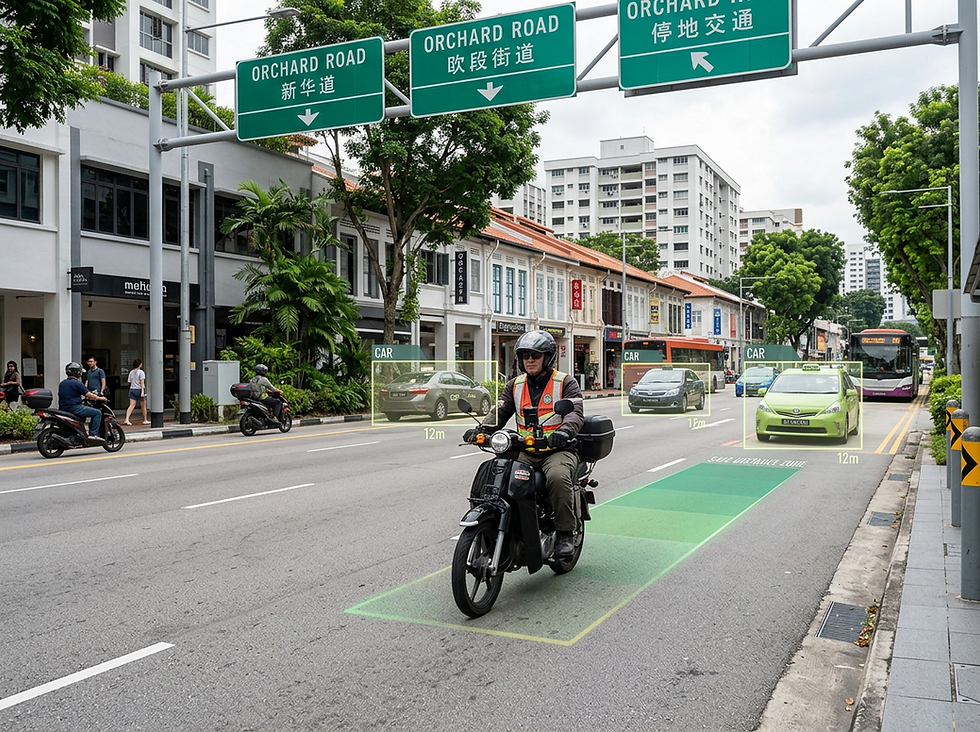
Cameras, by contrast, capture visual context. With the right AI models, a camera system can identify and classify a wide range of objects and road features, including:
Traffic signs
Lane markings
Pedestrians
Vehicles
Road hazards
Traffic lights
Road edges
Curbs and barriers
Debris and unusual objects
This matters because riding is a context-heavy activity. A motorcycle does not only need to know that “something” is ahead. It benefits from knowing whether that object is a car braking at a junction, a pedestrian stepping off the kerb, a red traffic light, a pothole, or a lane marking that indicates a curve.
Radar can tell a system that an object exists and is moving at a certain speed. A camera can help explain what that object is and why it matters.
Richer scene understanding supports better rider assistance
For next-generation motorcycles, the goal is not simply to add another warning light to the cockpit. The goal is to provide timely, accurate, and useful assistance without distracting the rider.
Camera-based ARAS helps achieve that because it can interpret the wider riding environment. For example, a camera can detect that a vehicle ahead is slowing near a pedestrian crossing, that a traffic light has changed, or that a rider is drifting towards a lane boundary. It can also recognise fixed road features that radar may struggle to classify, such as signs, painted markings, and road surface hazards.
That richer perception can support features such as:
Forward collision alerts
Lane departure warnings
Blind spot and rear approach alerts
Traffic sign recognition
Hazard detection
Context-aware visual or audio alerts
For OEMs, this creates a more flexible safety platform. Instead of building one hardware setup for one function, a camera-based system can support multiple current and future functions through software.
Cameras unlock value beyond rider assistance
The biggest advantage of camera-based ARAS may be that the same sensing platform can serve use cases far beyond real-time alerts.
A camera is not only a sensor. It is also a source of visual evidence, riding memories, training data, and service data. That creates new value for OEMs, riders, fleet operators, and insurers.
Camera-based systems can support:
Dashcam recording for accident evidence
Video can show what happened before, during, and after an incident. That evidence can help clarify fault, support claims, and reduce disputes.
Recording scenic rides
Riders often want to capture memorable roads and journeys. A built-in camera system can make that part of the motorcycle experience without needing extra devices or mounts.
Insurance claims and fraud prevention
Many insurance workflows depend on visual proof. Video footage can show road position, traffic conditions, signals, vehicle behaviour, and the exact sequence of events. Radar alone cannot provide that same evidence.
Rider coaching and fleet analytics
For rider training, delivery fleets, shared mobility, and performance-oriented users, recorded ride data can help identify patterns. Examples include harsh braking, unsafe following distances, repeated lane departures, or poor hazard response.
AI software updates that add new features
As AI models improve, the same camera hardware can support new capabilities through software updates. That fits the direction of software-defined motorcycles, where value continues to grow across the vehicle lifecycle.
This broader value stack is one reason camera-based ARAS is becoming attractive at the platform level, not just as a safety feature.
Insurance use cases make video especially important
Insurance is a clear example of where camera-based systems have a practical edge.
A radar system may show that another vehicle was approaching or that relative speed changed quickly. That information is useful, but it does not show the full scene. It cannot show whether a traffic light was red, whether a vehicle crossed a solid line, whether a pedestrian entered the road, or whether road debris caused the rider to react.
Video footage can provide that context. It can support:
Faster claims review
Better accident reconstruction
Fraud detection
Dispute resolution
Rider behaviour assessment
Fleet risk management
Many of these use cases require actual visual evidence. They cannot be achieved with radar alone. For insurers, that makes camera-based ARAS a potential bridge between safety technology, claims operations, and new data-driven insurance models.

OEMs need flexible integration, not one fixed package
For motorcycle manufacturers, the right ARAS solution must fit product design, electrical architecture, cost targets, and brand experience. A sport bike, touring motorcycle, scooter, and electric commuter may all need different packaging and user interface choices.
RiderDome’s camera-based ARAS platform is designed specifically for OEM integration. It offers flexible paths depending on how much control the manufacturer wants over hardware, compute, and user experience.
OEMs can choose from several integration models:
Complete hardware solution
AI processing board or SoC integration
Software-only integration
A ready system for manufacturers that want a faster path to implementation.
A compute-focused option for OEMs building around their own vehicle architecture.
A path for manufacturers that want to run RiderDome’s AI on their chosen hardware platform.
This flexibility matters because motorcycle design leaves little room for bulky add-ons. Styling, aerodynamics, vibration, weather exposure, power limits, and dashboard layout all influence adoption.
RiderDome also gives OEMs choice in the rider interface. Manufacturers can use RiderDome’s Rider Alert Unit or design their own alert unit to match the motorcycle’s styling, cockpit layout, and brand language. That allows safety features to feel native to the bike rather than aftermarket.
AI models make camera systems stronger over time
A key reason camera-based ARAS is gaining traction is the speed of AI progress. Camera hardware can remain physically similar while software models become better at detection, classification, and prediction.
That has major implications for OEMs. A motorcycle platform launched today can gain new functions later if it has the right sensing and compute foundation. Improvements may include better hazard recognition, added object categories, region-specific sign recognition, or more refined alert logic.
This approach fits the broader move towards software-defined vehicles. Motorcycles can shift from static feature sets to systems that improve through software updates, selected feature releases, and connected services.
For product teams, this opens new lifecycle possibilities. For engineering teams, it creates a clearer reason to select sensing hardware that can support future software. For business teams, it supports services that extend beyond the first sale.

Camera-based ARAS is becoming the practical path forward
Radar will continue to play an important role in vehicle safety. Its ability to measure distance and speed is valuable, and in some conditions it can see things cameras may find harder to detect. A balanced sensor strategy may still make sense for certain premium or specialised motorcycles.
Yet for many OEM programmes, cameras offer the broader foundation. They support rider assistance, visual recognition, evidence capture, ride recording, insurance services, rider coaching, fleet analytics, and continuous AI improvement. That combination is difficult to match with radar alone.
As motorcycle manufacturers move towards AI-powered, software-defined motorcycles, camera-based ARAS is gaining strong traction across the industry. It gives OEMs a way to build safer products while also creating new digital value around the riding experience.
RiderDome is proud to help lead this transformation towards safer and smarter motorcycles.


Comments