
Why Camera Based ARAS Leads the Industry and Why RiderDme Stands Out
A rider does not only need to know that something is nearby. They need to know what it is, where it is moving, and what it means for the next few seconds on the road.
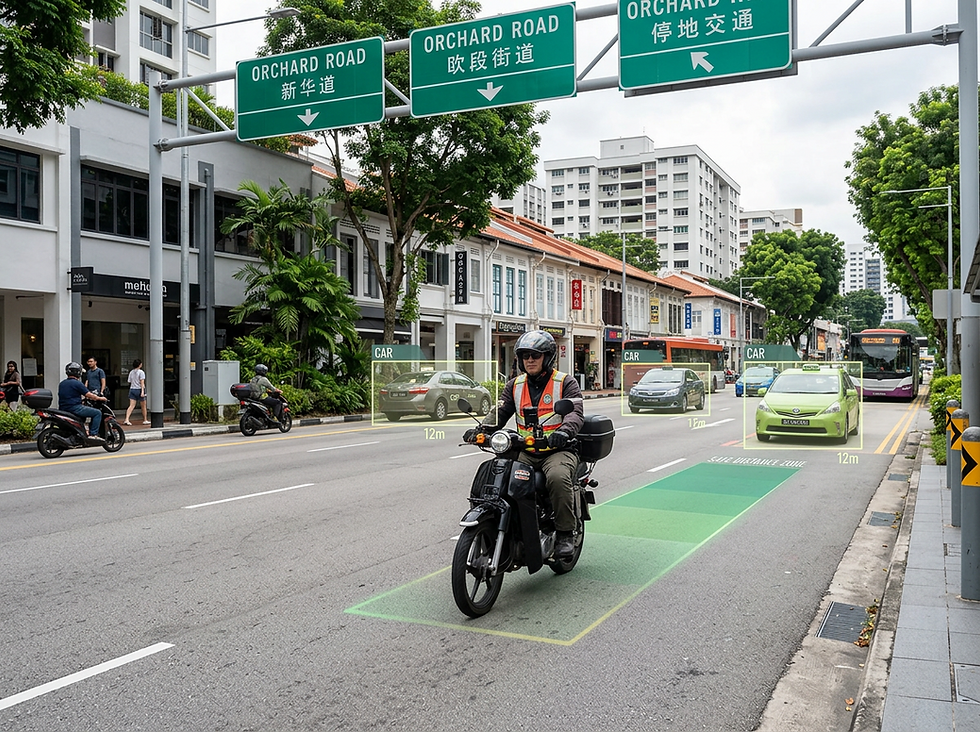
That is why camera based ARAS is becoming the natural direction for rider safety systems. Radar has a clear strength: it can detect objects in low light, rain, fog, and other difficult conditions. But road safety is more than object detection. Roads are full of lanes, signs, traffic lights, road markings, pedestrians, vehicles, and sudden behaviour changes. A camera can read that visual world in a way radar cannot.
For motorcycles, scooters, and fleet riders, this matters even more. Space is tight, reaction time is short, and every warning must be useful rather than noisy. A camera-first approach gives ARAS systems richer context, simpler installation, and video evidence when something goes wrong.
Cameras understand the road, not just the obstacle
Radar is excellent at measuring distance and movement. It can tell that an object is ahead and closing in. That is valuable, especially at night or in poor weather.
The limitation is that radar does not see the road the same way a rider does. It cannot read a speed limit sign. It cannot understand a lane marking. It cannot recognise a traffic light, a zebra crossing, or a vehicle cutting across a lane in the same visual way a camera can.
A camera based ARAS system can identify more of the driving scene, including:
Vehicles in front, beside, or approaching from different angles
Lane lines and road edges
Traffic signs and signals
Pedestrians, cyclists, and other vulnerable road users
Sudden braking or unsafe following distance
Road behaviour that suggests a near miss
This wider view is the main reason camera systems have moved from being an optional feature to becoming a practical standard. They give alerts based on meaning, not only movement.
For a rider, that difference is huge. A warning about a vehicle ahead is helpful. A warning that understands lane position, traffic flow, and visible hazards is better.
Video evidence changes the value of ARAS
One of the strongest advantages of cameras is simple: they record what happened.
Radar can detect that an object was present, but it cannot show the full scene. A camera can capture video before, during, and after an incident. That turns ARAS from a warning tool into a record of the ride.
This can help in several real-world situations:
Insurance claims after a collision or near miss
Fleet reviews when a delivery or transport rider reports an incident
Disputes over who changed lanes, stopped suddenly, or ignored a signal
Training and coaching for safer riding habits
Video does not replace proper investigation, but it adds clear context. It shows road markings, signal lights, surrounding traffic, and rider behaviour. That context can reduce guesswork.
For fleets, this is especially useful. A camera-based system can support safer riding while also helping managers understand risk patterns. For individual riders, it offers peace of mind. If an incident happens, there is a clearer record than memory alone.
Camera systems are easier to install and scale
Motorcycles do not have the same space, power supply, or mounting options as cars. Any safety system for riders must be compact, practical, and simple to fit.
This is where camera based ARAS gains another advantage. Radar systems often require careful positioning and alignment. If the sensor angle is wrong, detection quality can suffer. Some setups may need specialist calibration, especially when integrated deeply into a vehicle.
Camera-first systems can be designed for easier installation. A compact forward-facing unit can be mounted in a clear position, connected, and used without complex hardware changes. This makes adoption much easier for:
Individual riders who want added safety without rebuilding the bike
Fleet operators managing many motorcycles or scooters
Delivery teams that need quick fitting and low downtime
Service partners who need a repeatable installation process
The simpler the setup, the faster ARAS can move from premium vehicles into everyday use.
That is a key reason the industry is shifting. A safety system only helps if people can actually install it, maintain it, and trust it every day.
Why radar still matters, but cameras lead
The best safety discussion should be fair. Radar is not outdated. It has real strengths.
Radar performs well when lighting is poor. It can detect objects in darkness, glare, rain, or mist. It is also good at measuring relative speed and distance. These are useful capabilities for collision warning and adaptive systems.
But radar alone gives limited understanding of the wider road environment. It cannot provide visual evidence. It cannot read signs or lane markings. It cannot show what happened during an insurance claim.
Cameras lead because they add the missing layer: visual intelligence.
Radar strength | Camera advantage |
Works well in many lighting conditions | Sees signs, lanes, traffic lights, and road users |
Measures speed and distance well | Understands road context and visual behaviour |
Detects objects ahead | Records video evidence for claims and reviews |
Useful for specific detection tasks | Easier to fit in compact rider-focused systems |
For rider safety, the strongest system is one that gives meaningful warnings without adding complexity. Camera-based ARAS does that well because it sees the same road cues that a rider relies on.
Why RiderDme stands out in the domain
RiderDme stands out because it focuses on what riders and fleets need in daily use, not only what looks impressive on a specification sheet.
A strong ARAS product for motorcycles must do four things well.
It must understand the road scene.
RiderDme’s camera-based approach is built around visual context. That means the system can look beyond vehicles and recognise the broader riding environment, including lanes, signs, and other visible hazards.
It must provide useful evidence.
Because the system can record video, it supports incident review and insurance-related documentation. This gives riders and fleet operators more than alerts. It gives them a record they can refer to when clarity matters.
It must be easy to install.
A rider assistance system should not require complicated setup before it becomes useful. RiderDme’s camera-first design supports practical installation without the heavy calibration demands often linked with more complex sensor systems.
It must fit the rider’s world.
Motorcycles face vibration, limited mounting space, mixed road conditions, and fast-changing traffic. A system made for riders must respect those limits. RiderDme’s strength is its focus on this specific use case rather than treating motorcycles like smaller cars.
That rider-first focus is what makes the difference. The technology is not only about detecting danger. It is about giving the rider a clearer, calmer, and more reliable way to respond.
The road ahead belongs to visual intelligence
Camera based ARAS is becoming the industry standard because it matches the real demands of the road. It sees more than distance. It reads lanes, signs, signals, vehicles, and people. It records video that can support insurance claims and incident reviews. It is also easier to install on motorcycles and scooters, where simplicity matters.
Radar still has a role, especially in difficult lighting and weather. But when the goal is to understand the road as a rider sees it, cameras offer a fuller picture.
RiderDme stands out because it brings that camera-first advantage into a practical rider safety system. It focuses on context, evidence, and ease of use. Those are the things that turn ARAS from a technical feature into everyday protection.


Comments