
RiderDome Vision AI Transforming Motorcycle Safety for Fleets and OEMs
Motorcycles and scooters move through gaps that cars cannot. That freedom is part of their value, but it also creates a safety problem that older vehicle technology was not built to solve.
A car driver sits inside a wide body, surrounded by airbags, sensors, crumple zones, and increasingly advanced driver assistance systems. A rider has balance, judgement, protective gear, and a small contact patch on the road. When danger appears from behind, from the side, or in a blind spot, reaction time matters.
That is where RiderDome Vision AI changes the conversation. Instead of treating two-wheelers as smaller cars, it treats them as their own category, with their own movement, risks, road position, and safety needs. RiderDome leads the market with an AI-based safety system designed for motorcycles, scooters, delivery fleets, shared mobility operators, and OEMs building the next generation of connected two-wheelers.

Two-wheelers need safety technology built for riders
Most road safety systems began with cars. Cameras, radars, lane warnings, and collision alerts were shaped around four wheels, a fixed cabin, and predictable vehicle width. That does not translate neatly to motorcycles.
A motorcycle leans into bends. A scooter can sit near the edge of a lane. A rider may legally filter through traffic in some markets. Delivery riders stop and start often, park in tight spaces, and move through mixed traffic for long hours. A conventional car-oriented safety model can miss the small but critical details of two-wheeler behaviour.
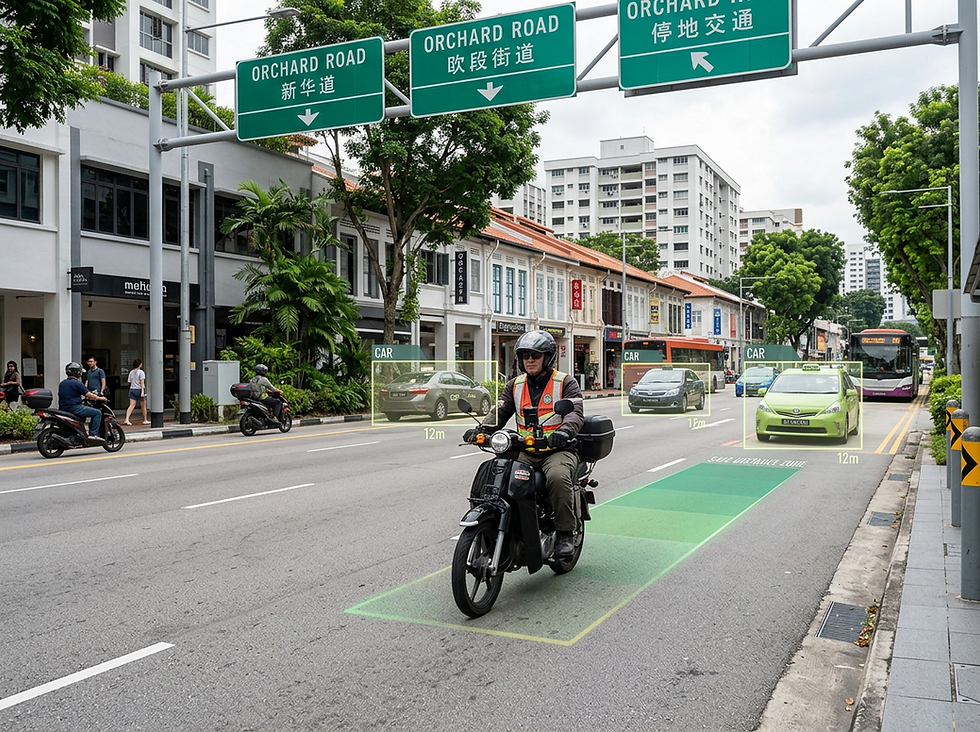
RiderDome’s Vision AI system is built around the riding experience. It uses computer vision to help detect risks around the rider and deliver warnings when they matter. The goal is simple: give the rider more time to respond.
That extra moment can help in situations such as:
A vehicle closing in from the rear
A car drifting near the rider’s lane position
A blind spot during a lane change
A fast-approaching vehicle at a junction
Traffic suddenly compressing in front
A delivery rider re-entering traffic after a stop
The best rider assistance does not distract. It supports awareness without taking over. Motorcyclists still need skill, attention, and judgement. RiderDome adds a second layer of perception, especially for risks that are hard to track while managing speed, mirrors, body position, road surface, and surrounding traffic.
This is why Vision AI is such a good fit for two-wheelers. A camera-based system can read the road scene in context. It can be trained to understand vehicles, distance, direction, and movement around a rider. It is not just about detecting an object. It is about understanding whether that object could become a threat.
How RiderDome Vision AI changes daily riding
A strong motorcycle safety system must work in real riding conditions, not only in a clean test environment. Roads are messy. Riders deal with glare, rain, impatient drivers, buses, pedestrians, roadworks, and sudden lane changes.
RiderDome focuses on practical risk detection. Its value comes from the way it helps riders notice danger sooner, especially when attention is split.
For example, a rider may check the mirror before changing lanes, but a vehicle in the blind spot can appear at the wrong moment. A Vision AI warning gives the rider another cue before making the move. In dense traffic, that cue can prevent a risky merge.
On motorways, rear collision risk is a major concern for motorcyclists. A rider cannot always monitor fast-approaching vehicles from behind, especially while maintaining safe distance ahead. A rear-facing vision system can help identify closing traffic and alert the rider.
At low speeds, the risk changes. Scooters and motorcycles weave through cars, stop near kerbs, and pass doors, pedestrians, and delivery pick-up points. Here, awareness must be constant. If the system can help flag nearby moving hazards, it reduces the chance that a rider misses something in the rush of repeated stops.
The key benefit is earlier awareness. RiderDome does not need to replace rider skill. It strengthens it.

Good rider technology must also respect the way people ride. Alerts should be clear, timely, and easy to understand. Too many false alarms can train riders to ignore the system. Too little feedback can make the system feel invisible. The balance is in giving meaningful warnings at the right time.
That matters for private riders, but it is even more important for fleets.
Fleets gain safety, consistency, and clearer operations
Two-wheeler fleets are now part of daily urban life. Food delivery, grocery delivery, courier services, medical deliveries, field technicians, security patrols, and shared mobility operators all depend on scooters and motorcycles.
For fleet operators, motorcycle safety is not only a personal issue. It affects operations, availability, insurance discussions, rider retention, customer service, and brand trust. Every incident can mean vehicle downtime, claims handling, delivery disruption, and a rider out of work.
RiderDome gives fleets a way to raise safety standards across many riders and many vehicles. That is hard to do through training alone. Training matters, but riders face pressure on the road every day. AI-assisted safety can support better habits during actual rides.
For fleets, the benefits tend to fall into four areas.
1. Better rider protection
Riders are the centre of the operation. A fleet that invests in active safety sends a clear message: the person on the bike matters. Systems that help detect blind spots, rear hazards, and nearby traffic can reduce exposure to common urban risks.
2. More consistent safety behaviour
Fleets often include riders with different experience levels. Some know the roads well. Others are new to a route, city, or vehicle type. AI safety support creates a more consistent safety baseline across the fleet.
3. Useful risk visibility
Fleet managers do not need more noise. They need clear patterns. A system that can show where risk appears, when alerts occur, and which routes create repeated exposure can help managers improve training, routing, and vehicle deployment.
4. Lower operational friction after incidents
When something goes wrong, clear event data can help explain what happened. This can support internal reviews, coaching, and claims discussions. It also helps fleets move from blame to prevention.
For delivery and shared mobility fleets in dense cities, these points are not theoretical. Riders spend hours near cars, vans, buses, pedestrians, cyclists, and ride-hail vehicles. The road scene changes by the second. A two-wheeler safety system has to work with that level of complexity.

RiderDome’s position in the market is strong because it addresses this fleet reality directly. It is not only a rider aid sold one vehicle at a time. It is a safety layer that can scale across operations.
A fleet solution must be easy to fit, simple to manage, and useful beyond the first week of installation. It has to serve riders on the road and managers who need to keep vehicles moving safely. RiderDome’s approach speaks to both sides.
OEMs can build safer two-wheelers from the start
OEMs face a different challenge. They are not managing yesterday’s fleet. They are designing tomorrow’s motorcycles and scooters.
For manufacturers, safety is becoming a stronger point of difference. Riders increasingly expect technology that was once limited to cars. Regulators and insurers are also paying closer attention to active safety. Connected vehicles are no longer a premium-only idea. They are becoming normal across more categories.
RiderDome gives OEMs a way to bring Vision AI safety into the vehicle platform itself. That matters because factory integration can create a cleaner, more complete experience than adding devices later.
An OEM integration can support:
Better camera placement
Neater wiring and power management
Integrated alerts through the vehicle display or haptic feedback
Consistent performance across a model line
Stronger service and maintenance processes
A clearer safety story for buyers
This is especially relevant for electric scooters and motorcycles. Many electric two-wheelers already use connected dashboards, telematics, battery management systems, and mobile apps. Adding AI-powered safety fits naturally into that direction.
For OEMs, the question is not only whether a feature works. It is whether the feature can fit the product, manufacturing process, cost structure, and customer experience. RiderDome’s value is that it focuses on the specific needs of two-wheelers rather than adapting a car system after the fact.
That gives manufacturers room to design safety as part of the ride itself. A rider should not feel that a system was bolted on as an afterthought. The alerts, display, hardware placement, and behaviour should feel natural from the first kilometre.

OEMs also need partners that understand scale. A safety system for a few test bikes is different from a system that can support full production, after-sales service, updates, and model variations. RiderDome leads the market because it connects the technology vision with the practical needs of manufacturers.
Why RiderDome is setting the pace in two-wheeler safety
The two-wheeler world is large and varied. A premium motorcycle, a city scooter, a delivery fleet bike, and a shared mobility vehicle all face different use cases. Yet they share one basic need: better awareness around the rider.
RiderDome stands out because it works from that need outward. Its Vision AI system is not trying to turn motorcycles into cars. It gives two-wheelers a safety model that respects how they move.
That market leadership comes from several strengths.
A clear focus on two-wheelers
Many safety technologies treat motorcycles as a secondary market. RiderDome puts them first. That focus shapes the detection logic, hardware choices, alerts, and use cases.
A solution for both fleets and OEMs
Some products only suit aftermarket installation. Others only make sense at factory level. RiderDome serves both paths. Fleets can add safety to vehicles already on the road, while OEMs can build the system into new models.
A practical role for AI
AI can sound abstract, but its value here is concrete. It helps the system interpret visual information around the bike and identify risk patterns. The rider receives help at the moment it is needed.
A better fit for modern mobility
Cities rely heavily on two-wheelers. They reduce congestion, support delivery networks, and give people flexible transport. Safer motorcycles and scooters can make that mobility more sustainable, more trusted, and easier to manage.
This last point matters. The growth of two-wheelers should not mean accepting higher risk as the cost of convenience. Safety technology can help the category mature.
RiderDome’s work points to a future where riders are not left with mirrors and instinct alone. They can have intelligent support designed around their real movement on real roads.
The road ahead for motorcycle safety
Motorcycle safety will always depend on skilled riders, responsible drivers, good infrastructure, and proper training. No AI system removes the need for attention or judgement. But technology can close gaps that have existed for too long.
Blind spots, rear hazards, and fast-changing traffic are part of everyday riding. RiderDome Vision AI gives two-wheelers a stronger way to sense and respond to those risks. For fleets, it can raise safety standards across daily operations. For OEMs, it can make active safety part of the vehicle design from the beginning.
The most important change is not the camera, the algorithm, or the alert alone. It is the shift in mindset. Two-wheelers deserve safety systems built specifically for them.

RiderDome is leading that shift with a system that serves riders today and manufacturers building what comes next. As motorcycles and scooters become more connected, active safety will move from a premium extra to a core expectation.
For the two-wheeler world, that is a safer direction to ride in.


Comments